




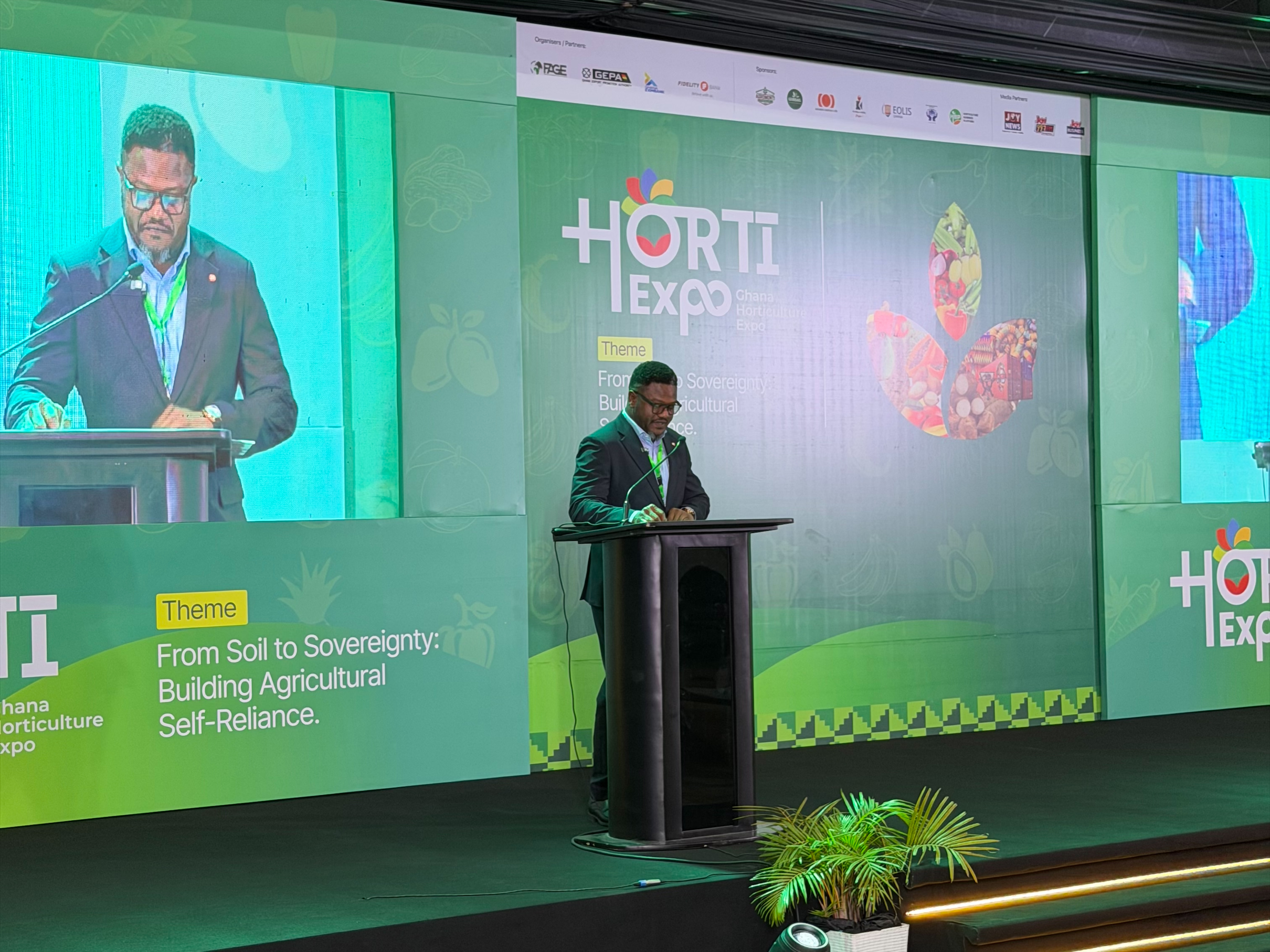
Fidelity Bank Ghana has called for a fundamental shift in how Ghana finances and structures its agricultural sector, arguing that the country’s path to agricultural self-reliance lies not in producing more, but in capturing more of the value created from what it already grows.
The call was made at the Ghana Horticulture Expo 2026, held under the theme “From Soil to Sovereignty: Building Ghana’s Agricultural Self-Reliance Through Innovation,” where the bank participated across multiple sessions as a long-standing partner of the event.
Delivering an address on behalf of Managing Director Julian Opuni, John-Paul Taabavi, Divisional Director for Corporate and Institutional Banking, framed the challenge through a single comparison. Ghana’s non-traditional agricultural exports generated approximately US$710 million in 2025, while cocoa paste alone generated approximately US$789 million over the same period.
“Both were produced from the same soil, the same country, the same growing season, ” Mr. Taabavi said. “Yet the value of a single product exceeded the value of an entire category of agricultural exports. The difference lies largely in what happens after the harvest.”
He argued that agricultural sovereignty does not mean producing everything domestically, but rather controlling more of the value Ghana creates, retaining more income within the economy, and ensuring more Ghanaian businesses participate in the wealth generated by Ghanaian agriculture.
With non-traditional exports reaching approximately US$5 billion in 2025 and Ghanaian products now reaching 152 countries, he noted that demand is not the constraint. The greater challenge sits between the farmer and the market, i.e., cold storage, aggregation, processing, packaging, logistics, quality standards, certification, reliable energy, and access to appropriate finance.
Mr. Taabavi also challenged conventional thinking on agricultural risk. “We often say agriculture is risky. But is agriculture inherently risky or are we sometimes creating risk through the way we choose to finance it?” he asked, calling for financing structured around production cycles, verified transactions, credible off-take agreements, and warehouse receipts rather than traditional collateral alone.
He pointed to the Fidelity Export Club, established in 2023 in partnership with the Federation of Associations of Ghanaian Exporters (FAGE), as a working model. The initiative now supports more than 400 exporters and farmers, and through the BRIDGE-in-Agriculture programme with the Mastercard Foundation and the bank’s broader SME channels, Fidelity Bank has disbursed more than GHS 160 million to FAGE members. By the end of July 2026, members within the bank’s SME portfolio had generated approximately US$40 million in foreign exchange inflows.
Speaking on SME exports, Alex Amponsah-Agyei, Director of SME Banking, described the bank’s deliberate work to de-risk agricultural lending through partnerships with Ghana Incentive-Based Risk-Sharing System for Agricultural Lending (GIRSAL), the eco.business Fund, the Mastercard Foundation, and Development Bank Ghana.
He explained that these collaborations have made it possible to lend at a total cost of 7% under the Mastercard Foundation BRIDGE-in-Agriculture initiative, and to accept farmland as security, a departure from traditional practice. “If you want to look at farming and aggregation and export, then you need to look at the entirety of the value chain,” he said. “It cannot be that you have funded the customer, the goods get to the port, and suddenly there is a letter of credit issue.”
James Orraca-Tetteh, Head of Commercial Banking, reinforced the role of partnerships in reshaping how banks serve exporters. “Where we are going, we have to be more creative than the traditional way, and that is what some of these partnerships offer,” he said, pointing to the Fidelity Young Entrepreneurs Fund as an example of ring-fenced concessionary financing paired with structured capacity building for youth and women in agribusiness.
Fidelity Bank has been a partner of the Ghana Horticulture Expo since its inception. “We intend to continue showing up, not simply as a sponsor, but as a committed partner in building the value chains that create jobs, expand exports, and unlock shared prosperity,” Mr. Taabavi said. “Sovereignty is not created at the farm gate. It is created when innovation, investment and enterprise transform what comes from our soil into lasting national prosperity.






Comments are closed